

Diablo Magazine Best ofthe East Bay 2025

Best of the East Bay 2025

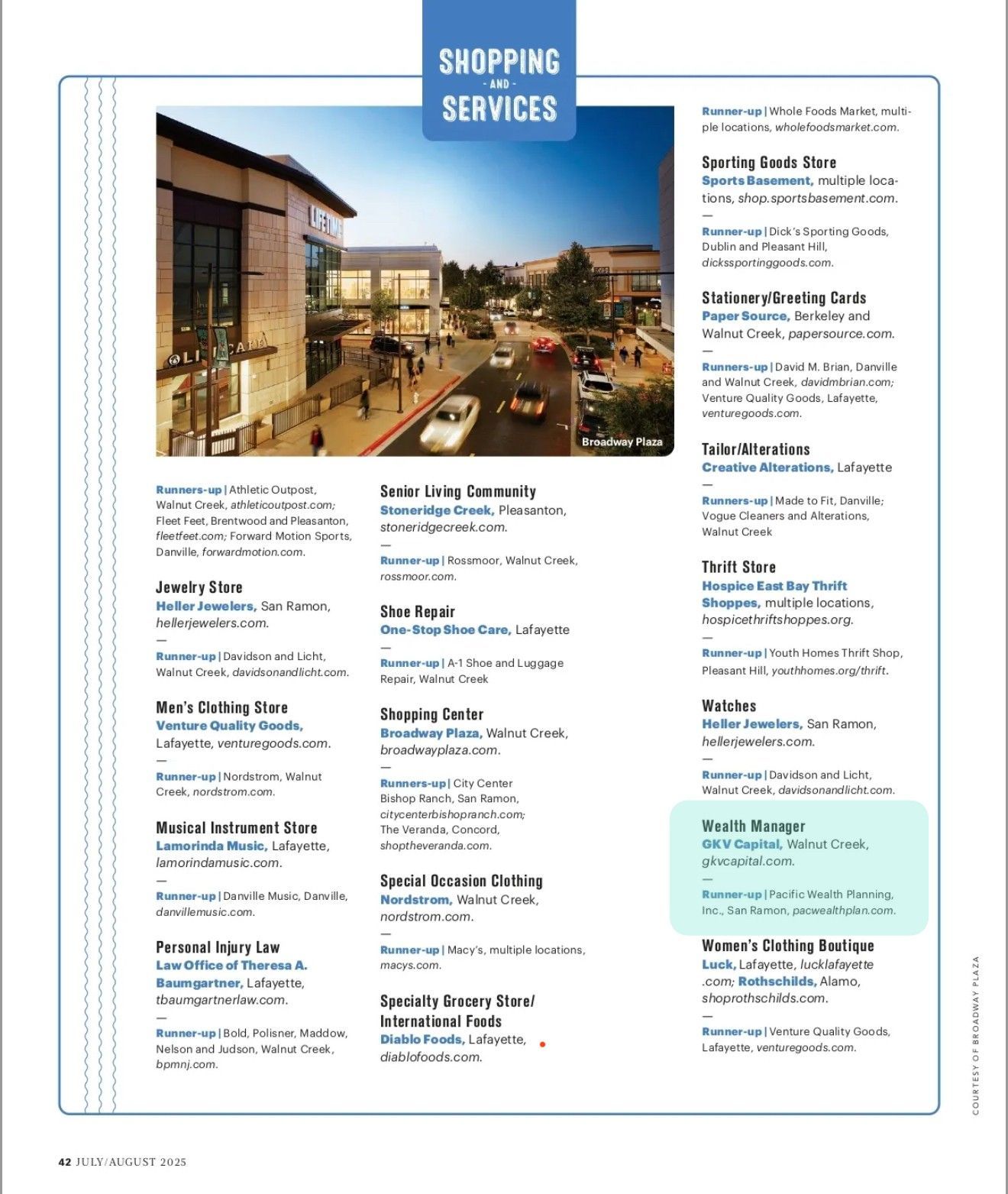
We’re excited to announce that Pacific Wealth Planning, Inc. was named a Runner-Up for Diablo Magazine’s Best of the East Bay 2025 in the July issue, released today.


This recognition was a huge surprise, and we’re deeply grateful to everyone who nominated us. Although we didn’t win first place, being acknowledged among the best in the East Bay is a true honor. Thank you for your incredible support.


We look forward to continuing to serve our wonderful community.

February 17, 2026
Small and Mid-Caps Are Re-Entering the Conversation
February 12, 2026
Beyond Big Tech: The Global Surge in AI Adoption and Implications for Investors
January 29, 2026
Key Takeaways ETFs are no longer just passive, low-cost vehicles. Active management, leverage, and complex strategies now define a significant and growing portion of the ETF universe. Choice and innovation come with tradeoffs. While product variety has increased, so have fees and structural complexity—raising the stakes for fund selection. Advisor due diligence is more critical than ever. In an ETF landscape with growing complexity, maintaining portfolio discipline and aligning exposures with client objectives requires deep and consistent analysis. The ETF Market is Structurally Shifting For years, investing in an exchange-traded fund (ETF) meant investing passively in an index. ETF investors bought portfolios designed to capture the returns of an index, like the widely followed S&P 500, by matching the holdings of the index. This approached allowed portfolios to replicate the performance of the index, but gave up the prospect of outperformance. This is in contrast to active management, which attempts to outperform an index. That convention reflected reality: regulatory and structural constraints made it difficult (often impractical) to deliver active management within an ETF wrapper. As a result, mutual funds remained the primary vehicle for active strategies. That paradigm shifted in 2019, when updated rules opened the door for active management in ETFs. Asset managers moved quickly to capitalize, and the market responded. With more than 5,000 ETFs now trading, surpassing the total number of publicly listed stocks, the investment landscape has become far more crowded than it was a decade ago. New product launches and asset flows reveal that ETFs have become the investment vehicle of choice, reflecting their success in lowering costs, improving tax efficiency, and broadening access to markets.
More Posts