

Iran, Oil, and the Long Road to Resolution
Iran, Oil, and the Long Road to Resolution
Key Takeaways
- The longer the U.S.-Iran conflict persists, the more upward pressure it places on oil prices, inflation, and interest rates, creating a headwind for consumers, economic growth, and financial markets.
- Higher energy costs are being felt unevenly across the economy. Lower-income households face the greatest pressure because they spend a larger share of their budgets on essentials like gasoline and food.
- Despite higher oil prices and ongoing geopolitical uncertainty, other powerful forces, including strong corporate earnings, artificial intelligence-driven investment, and resilient economic activity, have helped offset some of the conflict's impact on markets.
Nearly six months old, the U.S.-Iran conflict has lasted longer than many expected, and a durable resolution appears elusive. In mid-June, the two sides struck an interim peace deal, but it was only a matter of weeks before tensions flared again. Renewed hostilities have effectively closed the Strait of Hormuz, a critical choke point for global oil supplies, once more.
In this week’s Markets in a Minute, we revisit the conflict’s economic and market impacts, and explore questions that remain top of mind for investors as the conflict grinds on. What are the implications, for instance, of a longer conflict, rather than the short-lived shock that many expected? And if the conflict ends tomorrow, will global oil supplies bounce back quickly? Read on for our take these and other questions.
Household Budgets Squeezed (Unequally)
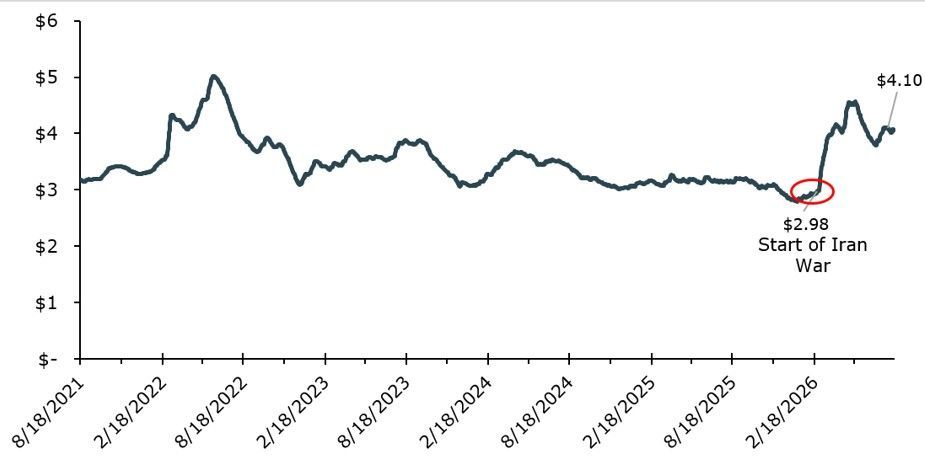
Disruptions to the global supply of crude oil, the main ingredient in gasoline, have caused dramatic swings in gas prices. In late May, the national average retail price of regular gas peaked at $4.56 per gallon, up from less than $3 per gallon at the start of the year.
Average Price per Gallon of Regular Gasoline in the U.S.
Past performance is not a reliable indicator of current or future results. Indexes are unmanaged and not subject to fees. Forward-looking estimates may not come to pass. Note: views are from a U.S. dollar perspective Source: Kestra Investment Management with data from Bloomberg, Daily National Average Gasoline Prices Regular Unleaded. Data as of August 16, 2026.
Consumers got some relief when the conflict appeared to be winding down in the late spring, only to see prices climb again (albeit less sharply) with the resumption of hostilities. High gas prices are not only causing pain at the pump but driving up prices for food and other goods.
When consumers are forced to spend more on gas and other essentials, they usually have less disposable income for discretionary purchases, like dining out or travel. The cumulative effect can be a drag on the broader economy.
But it’s worth noting that the pain of higher prices isn’t felt equally across the income spectrum. Lower-income consumers tend to spend a much larger share of their budgets on gas and other essentials than wealthier households do. In 2024, energy expenditures accounted for 17% of total income for households in the bottom 20% of the income distribution, compared with just 2.7% for those in the top 20%, a burden more than six times as large. This explains why higher-income Americans have been able to absorb steeper prices without making as many compromises in their spending habits.
Higher Rates and a Headwind for Stocks
What happens at the gas pump and in the grocery aisle has other downstream effects. The longer inflation remains elevated, the more pressure there is on the Federal Reserve to potentially increase interest rates. This year, investors have gone from expecting two rate cuts to pricing in the possibility of rate hikes instead.
The shift in expectations around inflation and monetary policy has pushed Treasury yields higher — particularly at the long end of the curve — and driven up key borrowing costs. The average rate on a 30-year, fixed-rate mortgage climbed from roughly 6% in late February to about 6.7% in early August, putting pressure on an already lackluster housing market.
Rising yields have also weighed on stock prices. When yields rise because investors expect stronger economic growth, the upswing can support equity prices. But, as we’ve seen this year, when yields rise because investors expect inflation to climb, it can be a headwind for stocks.
The Bigger Picture
For as long as it lasts, the conflict will increase inflationary pressures and be a drag on economic growth. That said, it’s just one piece of a complicated puzzle affecting investment returns. Fortunately, many of the other pieces are looking pretty good right now.
The artificial intelligence boom, for instance, has been a tailwind for the U.S. economy, corporate earnings and stock prices, helping to offset the effects of higher inflation. The buildout of AI infrastructure and adoption of the technology have contributed to robust earnings growth across several S&P 500 sectors, including Communications Services, Information Technology, Industrials and Utilities.
Over the next several years, the economy should continue to benefit from massive investments in AI and productivity gains tied to wider adoption. To be sure, there are legitimate questions about whether billions of dollars in capital expenditures on AI will ultimately translate into durable returns for companies at the forefront of the technology. For now, however, the broader story remains quite positive.
Interestingly, higher oil prices have been boon to one corner of corporate America, namely energy companies. Over the last 18 years, the U.S. has dramatically increased oil production, becoming a net exporter in 2020. So, higher oil prices tend to translate into higher revenues and earnings for the domestic energy sector.
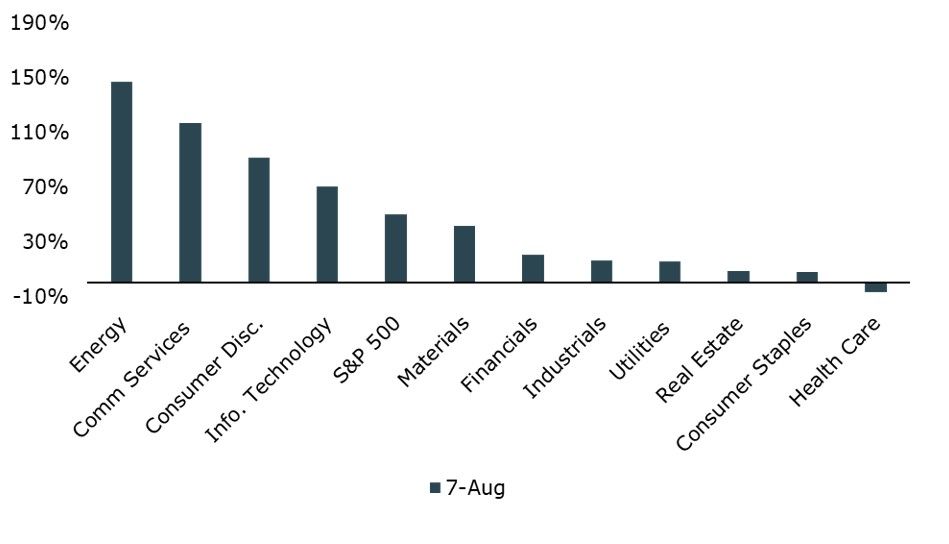
In the second quarter, the S&P 500’s blended year-over-year earnings growth rate increased at its fastest pace in years (50.4%), according to FactSet. Energy led all 11 S&P 500 sectors, with earnings surging 147% from a year earlier.
S&P 500 Earnings Growth Year-Over-Year: Q2 2026
Past performance is not a reliable indicator of current or future results. Indexes are unmanaged and not subject to fees. It is not possible to invest directly in an index. Forward-looking estimates may not come to pass. Note: views are from a U.S. dollar perspective Source: Kestra Investment Management with data from FactSet Earnings Insight. Index: S&P 500. Data as of August 7, 2026.
Finding a Way Forward
What if the conflict continues in its current state for the foreseeable future?
The longer the conflict goes on, the greater the risk of lasting damage to the global oil supply. That said, given enough time, companies and countries tend to find creative ways of adapting to challenges. Many companies, for instance, have adjusted to higher tariffs by finding new suppliers, raising prices and changing inputs.
We’re seeing the same dynamic play out in the global oil market. Saudi Arabia, for example, has been sending more of its oil across the county to Red Sea ports, although the alternative route has recently come under pressure as well. Meanwhile, the United Arab Emirates, Iraq and Qatar are looking to expand existing pipelines and/or build new ones, giving producers more options for getting oil to global markets.
Even if the fighting ends tomorrow, it will take time to replenish the global oil supply, which means prices are likely to remain elevated for a while. Some production and refining capacity has been damaged during the conflict, and repairing the damage will take time. So will rebuilding the U.S. Strategic Petroleum Reserve, which is designed to cushion disruptions in energy supply. The reserve has been drawn down at a rapid rate during the conflict. As of mid-July, it had fallen to its lowest level in roughly four decades.
The Takeaway
The conflict has underscored the fact that predicting the exact timeline of any war is challenging. Many pundits predicted that the Trump administration would find a way to wind down the conflict, which remains deeply unpopular, well before the midterm elections, or right about now.
Far less attention has been paid to the pressure Iran faces to find a resolution. While the conflict has created an economic headache for the U.S., it’s given rise to a full-blown economic crisis in Iran, notes Ryan Bohl, Senior Middle East and North African Analyst at the RANE Network.
In the short term, Iran may have a higher pain threshold in part because public resistance to foreign attack has helped preserve a fragile national unity. But harsh economic realities could soon undermine that cohesion and increase pressure on Tehran to blink, according to Bohl.
In the meantime, the conflict will continue to dominate the headlines, which can make it easy to lose sight of positive trends. Even with elevated oil prices and lingering geopolitical uncertainty, corporate earnings have remained strong, stock prices have reached new highs and bonds have delivered positive returns. The conflict remains a risk, but, so far, the economy and the markets have proved remarkably resilient.
Invest wisely and live richly,
Kara
The opinions expressed in this commentary are those of the author and may not necessarily reflect those held by Kestra Advisor Services Holdings C, Inc., d/b/a Kestra Holdings, and its subsidiaries, including, but not limited to, Kestra Advisory Services, LLC, Kestra Investment Services, LLC, and Bluespring Wealth Partners, LLC. The material is for informational purposes only. It represents an assessment of the market environment at a specific point in time and is not intended to be a forecast of future events, or a guarantee of future results. It is not guaranteed by any entity for accuracy, does not purport to be complete and is not intended to be used as a primary basis for investment decisions. It should also not be construed as advice meeting the particular investment needs of any investor. Neither the information presented nor any opinion expressed constitutes a solicitation for the purchase or sale of any security. This material was created to provide accurate and reliable information on the subjects covered but should not be regarded as a complete analysis of these subjects. It is not intended to provide specific legal, tax or other professional advice. The services of an appropriate professional should be sought regarding your individual situation. Kestra Advisor Services Holdings C, Inc., d/b/a Kestra Holdings, and its subsidiaries, including, but not limited to, Kestra Advisory Services, LLC, Kestra Investment Services, LLC, and Bluespring Wealth Partners, LLC, do not offer tax or legal advice.