

The Selloff, The Comeback and What to Do Next
The Selloff, The Comeback and What to Do Next
Three key takeaways
- The correction reflects several pressures, but the sharpest losses remain concentrated among the technology companies that led the earlier rally.
- Economic growth and corporate earnings remain broadly supportive, suggesting that the market decline has not yet become a broader economic break.
- Volatility can expose unintended portfolio concentration, making this an appropriate time to review diversification and reconnect investment risk with long-term financial goals.
Last week capped off a difficult stretch of headlines and major financial news. The S&P 500 entered correction territory, commonly defined as a decline of at least 10% from a recent high, while the technology-heavy Nasdaq 100 approached the 20% threshold associated with a bear market.
The speed of the selloff has been unsettling, but the gap between the market and the economy remains notable. Technology stocks have fallen sharply, while economic growth and corporate earnings remain relatively resilient. So far, the decline looks more like an unwinding of a concentrated technology trade than evidence of a broader economic break.
Selloffs usually have multiple causes—this time is no different
No single event caused the correction. Investors have become less willing to accept the assumptions that supported the AI trade as technology stocks moved higher.
The question was and still is whether all this spending on AI will translate into profits: Will the investment being made today generate enough future cash flow to justify current valuations?
Companies are committing enormous sums to chips, data centers, power, water, and other infrastructure. Some will turn those investments into durable profits. Others may face rising competition, higher financing costs, rapid technological change, or slower adoption than expected.
Financing has added to the pressure. Technology companies need substantial capital to build AI infrastructure at the same time that investors are being asked to absorb new stock offerings and corporate debt. A larger supply of securities gives investors more room to demand lower share prices or higher bond yields.
Uncertainty over Federal Reserve policy, potentially becoming more hawkish, and the unwinding of crowded trades have intensified the selling. These pressures have developed over time, which helps explain why there is no single event or policy change that would quickly restore confidence.
A concentrated rally produced a concentrated correction
Technology companies led the market higher for years as investors embraced the potential of AI. The same concentration that supported the rally has now made the major indexes more vulnerable to weakness in a relatively small group of companies.
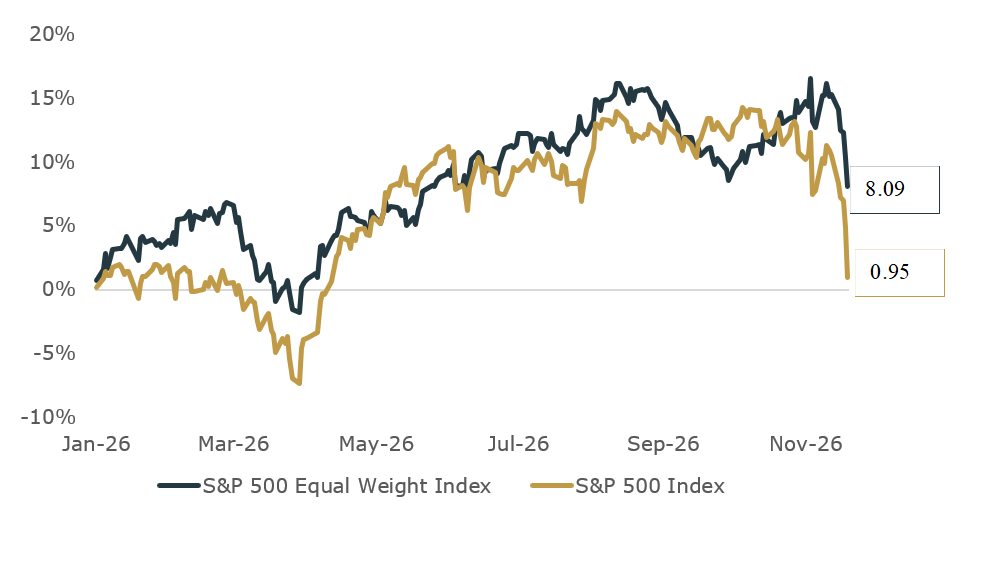
The market’s performance outside the largest companies tells a different story. The equal-weighted S&P 500, which gives every company the same influence, remained up over 8% for the year after falling 8.4% from its year to date high. The capitalization-weighted index, in which the largest technology companies carry much more influence, had fallen over 13% and was up less than 1%.
S&P 500 Equal Weight Index vs. S&P 500 Index
Year to date cumulative returns, as of November 20, 2026
Past performance does not guarantee future results. Indexes are unmanaged and not subject to fees. It is not possible to invest directly in an index.
Source: Kestra Investment Management with data from Factset. Data as of November 20, 2026
The equal-weight and market cap weighted indices have traded leadership throughout the year, but last week widened the gap—and shows how heavily the correction has fallen on the market’s largest companies. Technology weakness has begun to affect other assets, but the decline has not represented a uniform rejection of U.S. businesses.
This concentration has implications for investors because broad market exposure may contain more technology risk than expected. Years of strong performance can gradually increase a portfolio’s exposure to its largest holdings, even when the investor has made no deliberate change.
The economy has not confirmed the market’s warning
The broader economic risk is that weakness in technology stocks begins to affect business investment and consumer spending. Strong equity markets have supported household wealth and consumption, an important driver of U.S. growth. A prolonged decline could weaken that support, although there is little evidence of a meaningful pullback so far.
Economic growth remains positive, and earnings strength has extended beyond technology. According to FactSet, during the third-quarter earnings season, 84% of companies exceeded analysts’ earnings expectations and 74% surpassed revenue expectations. Materials, industrials, utilities, communication services, and health care each recorded year-over-year earnings growth above 9%.
That breadth does not eliminate market risk, but it argues against treating the correction as evidence that the entire economy is weakening.
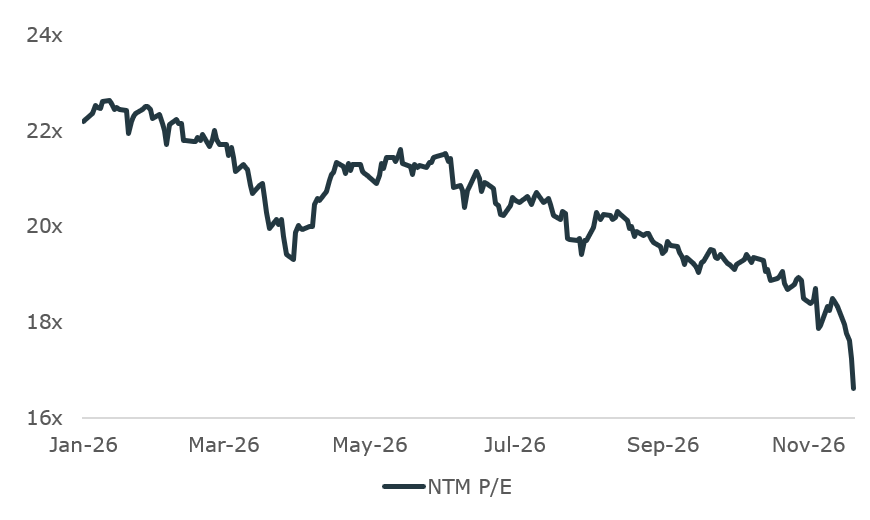
Valuations have also adjusted as stock prices have fallen. Lower valuations cannot prevent further losses, particularly if earnings estimates decline, but they indicate that markets have already absorbed a meaningful amount of disappointment.
S&P 500 Index Valuations Have Come Down
NTM Price to Earnings Ratio, year to date, as of November 20, 2026
Past performance does not guarantee future results. Indexes are unmanaged and not subject to fees. It is not possible to invest directly in an index.
Source: Kestra Investment Management with data from Factset. Data as of November 20, 2026
What to watch next
The direction of the market will depend in part on whether technology weakness remains concentrated or begins to affect business investment, employment, consumer spending, and corporate profits.
The funding environment for AI will also be important. Higher borrowing costs or weaker investor demand could force companies to slow projects, while evidence of rising productivity and stronger cash flow could restore confidence in the investment cycle.
Corrections often tempt investors to turn uncertainty into an all-or-nothing decision. Selling does not eliminate uncertainty. It replaces one difficult decision with another—when to reinvest. Markets often begin recovering before the news feels reassuring.
Periods like this are best viewed through the financial plan rather than through each day’s headlines. The relevant questions are whether recent gains created more concentration than intended, whether the portfolio still reflects the investor’s time horizon and spending needs, and whether the plan can withstand further volatility.
The goal is not to predict the next market turn. It is to make sure short-term market noise does not pull long-term goals out of focus.
The opinions expressed in this commentary are those of the author and may not necessarily reflect those held by Kestra Advisor Services Holdings C, Inc., d/b/a Kestra Holdings, and its subsidiaries, including, but not limited to, Kestra Advisory Services, LLC, Kestra Investment Services, LLC, Kestra Private Wealth Services, and Bluespring Wealth Partners, LLC. The material is for informational purposes only. It represents an assessment of the market environment at a specific point in time and is not intended to be a forecast of future events, or a guarantee of future results. It is not guaranteed by any entity for accuracy, does not purport to be complete and is not intended to be used as a primary basis for investment decisions. It should also not be construed as advice meeting the particular investment needs of any investor. Neither the information presented nor any opinion expressed constitutes a solicitation for the purchase or sale of any security. This material was created to provide accurate and reliable information on the subjects covered but should not be regarded as a complete analysis of these subjects. It is not intended to provide specific legal, tax or other professional advice. The services of an appropriate professional should be sought regarding your individual situation. Kestra Advisor Services Holdings C, Inc., d/b/a Kestra Holdings, and its subsidiaries, including, but not limited to, Kestra Advisory Services, LLC, Kestra Investment Services, LLC, Kestra Private Wealth Services, and Bluespring Wealth Partners, LLC, do not offer tax or legal advice.