

Private Credit: Between Pressure and Performance
Markets in a Minute: Private Credit: Between Pressure and Performance
The private credit space has grown enormously over the last decade, luring investors with juicy yields and borrowers with bespoke terms. More recently, however, several credit issues have caused concern and sent some investors rushing for the exits. Are these alarming headlines signs of more to come? Or are investors overreacting? In this week’s Markets in a Minute, we help separate fact from fiction in the private credit markets.
Key Takeaways:
- Private credit is growing up, not coming apart. As the asset class scales and attracts more retail capital, liquidity limits, valuation practices, and risk controls are being tested.
- Investor frustration appears more driven by liquidity limitations than deteriorating underlying credit.
- Underlying credit fundamentals appear stable. Key indicators remain broadly consistent with historical norms supported by senior‑secured positioning and sponsor capital.
What Is Private Credit?
Historically, when companies needed to borrow, they turned to banks or the public bond market. But after the Global Financial Crisis, banks became more constrained and private lenders stepped into the gap, particularly for mid-sized companies that might be too large for small banks yet too small for public markets. These mid-market companies were particularly drawn to the faster execution and more-customized terms that private lenders can offer.
Since then, private credit has grown from a niche corner of non‑bank lending into a core pillar of global finance. In the U.S. alone, estimates put private credit assets between $1.5 trillion and $1.7 trillion today, according to Russell Investments, representing roughly three‑quarters of the global market, with projections pushing the sector beyond $3 trillion by 2028. That kind of growth naturally attracts capital—and scrutiny.
In those years, private credit has delivered attractive returns. Investors were rewarded with higher yields than what could be found in public bonds and their portfolios were shielded from day-to-day market volatility (private credit investments are typically valued once a quarter whereas most bonds are priced at least daily).
Over time, borrower demand and investor appetite reinforced one another. Private credit stopped behaving like an alternative and began operating as core financing infrastructure.
What’s the Concern with Private Credit?
Three separate but related issues prompted the recent concern with private credit: borrower bankruptcies, the rising use of payments in kind and liquidity limitations.
Late last year, some credit issues surfaced, including the high-profile bankruptcies of First Brands Group and Tricolor Holdings, two companies that were widely represented in private credit portfolios.
In addition, many private credit borrowers began paying not in cash, but “in kind.” This phenomenon known as “PIK” or “payment in kind” allows a borrower to avoid paying interest and for the money owed to increase. Allowing companies to use PIK from the outset of a loan can give the borrower time to grow. Sometimes, though, borrowers can request to use PIK after a loan has already been made and that amendment can be seen as a sign of credit weakness.
By late 2025, roughly 11 percent of private loans used some form of PIK, with a growing share tied to borrower‑requested amendments. The trend at least partly reflects companies adjusting to a higher‑rate environment after a decade of cheap capital, rather than a systemic break in credit quality.
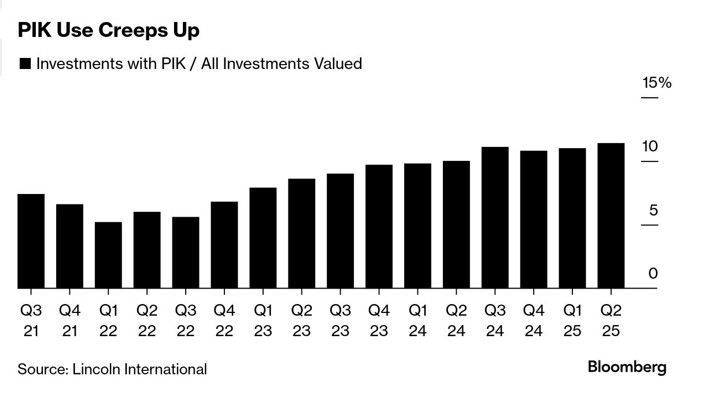
Importantly, rising PIK usage has not translated into a deterioration in realized credit outcomes. Non‑accrual rates remain near historical norms, roughly 1.5 to 2 percent, and realized losses continue to run below 1 percent annually, supported by senior‑secured structures and active sponsor involvement.
As high-profile bankruptcies made their way to headlines and PIK usage rose, some investors got spooked, attempting to withdraw their money and prompting a few funds to institute redemption gates. Just as investors were worried, they weren’t able to redeem their investments.
For instance, Blue Owl became the focal point of private‑credit concerns when investors sought to redeem about $5.4 billion—roughly 22% of its flagship Credit Income Corp. and 41% of a tech‑focused fund—in Q1 2026; in response, the firm enforced the standard 5%‑per‑quarter redemption cap, leaving the vast majority of withdrawal requests unmet.
To be clear, these funds behaved as they were designed. By their very nature, private loans don’t trade on an exchange like bonds or stocks, which means it can take time to find buyers of those loans. The redemption gates that most funds have are designed to manage the pace of exits in a way that preserves portfolio integrity rather than accommodate immediate liquidity demands. In fact, it is partly these redemption gates that enables private credit funds to offer higher rates of return.
What Should Investors Take Away?
Private credit has matured into a market that now absorbs the full weight of cycles, headlines, and scrutiny. That transition is not a flaw; it is the consequence of scale.
Risk is rising, but it is observable and structured. Liquidity limits are intentional. Credit fundamentals reflect adjustment, not collapse. Sentiment continues to move faster than underlying loan performance.
The defining feature of the current environment is coexistence. Risk and opportunity are rising together, sharpening the distinction between platforms with the discipline to price and manage uncertainty and those without.
This recent experience serves as an important reminder. Investors must do their due diligence and understand exactly what they own.
The opinions expressed in this commentary are those of the author and may not necessarily reflect those held by Kestra Advisor Services Holdings C, Inc., d/b/a Kestra Holdings, and its subsidiaries, including, but not limited to, Kestra Advisory Services, LLC, Kestra Investment Services, LLC, and Bluespring Wealth Partners, LLC. The material is for informational purposes only. It represents an assessment of the market environment at a specific point in time and is not intended to be a forecast of future events, or a guarantee of future results. It is not guaranteed by any entity for accuracy, does not purport to be complete and is not intended to be used as a primary basis for investment decisions. It should also not be construed as advice meeting the particular investment needs of any investor. Neither the information presented nor any opinion expressed constitutes a solicitation for the purchase or sale of any security. This material was created to provide accurate and reliable information on the subjects covered but should not be regarded as a complete analysis of these subjects. It is not intended to provide specific legal, tax or other professional advice. The services of an appropriate professional should be sought regarding your individual situation. Kestra Advisor Services Holdings C, Inc., d/b/a Kestra Holdings, and its subsidiaries, including, but not limited to, Kestra Advisory Services, LLC, Kestra Investment Services, LLC, and Bluespring Wealth Partners, LLC, do not offer tax or legal advice.